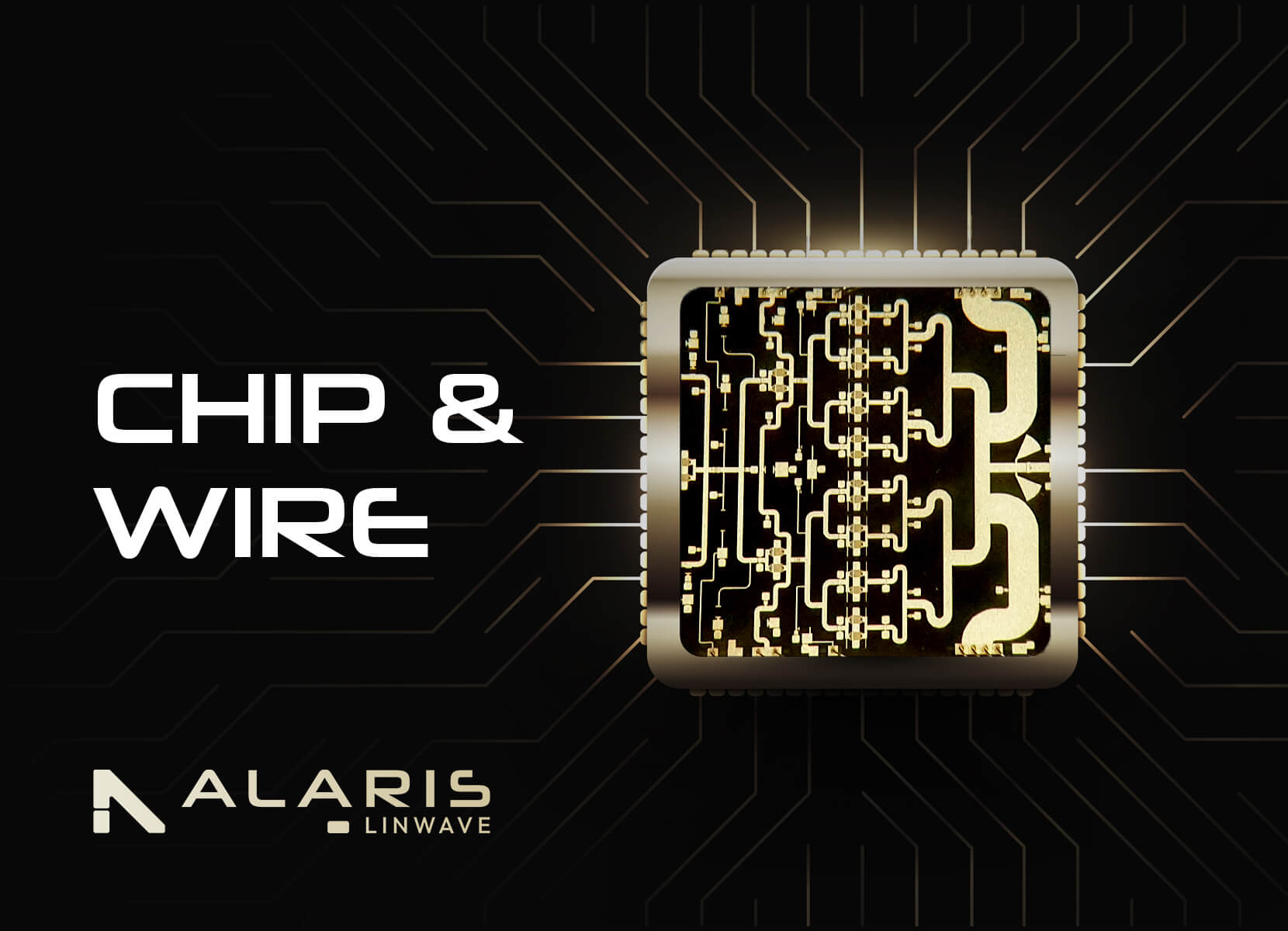
Alaris Linwave’s advanced Chip and Wire capability provides customers with an advanced RF solution when a packaged device is not available or will not provide the required performance.
In the RF and Microwave design world, a significant portion of a module’s functionality is delivered by Monolithic Microwave Integrated Circuits (MMICs). These semiconductor devices can perform a wide array of functions, including microwave amplification, attenuation, mixing, oscillation, and high-speed switching. Traditionally fabricated using Gallium Arsenide (GaAs), and more recently Gallium Nitride (GaN), most MMICs are housed in plastic or ceramic packages, facilitating ease of handling, testing, and soldering onto PCBs during the assembly process.
However, in certain scenarios, particularly at higher frequencies, packaged components may be unsuitable or unavailable. In such cases, MMICs are supplied as bare die or in wafer form. These die often offer superior RF performance, such as improved gain flatness and linearity, compared to their packaged counterparts. In some instances, suppliers provide components exclusively in die form.
Processing MMICs in die or wafer form presents significantly greater complexity than working with packaged parts. Die are often extremely small (less than 1 mm in length), necessitating the use of microscopes for precise handling and placement on PCBs or carrier circuits. Their delicate nature requires specialized tools and expert handling. Moreover, the bonding pads along the edges of the die are exceptionally small (typically <0.1 mm), and attaching the bond wires—responsible for carrying power and signal—demands highly sophisticated equipment and the skill of experienced operators.
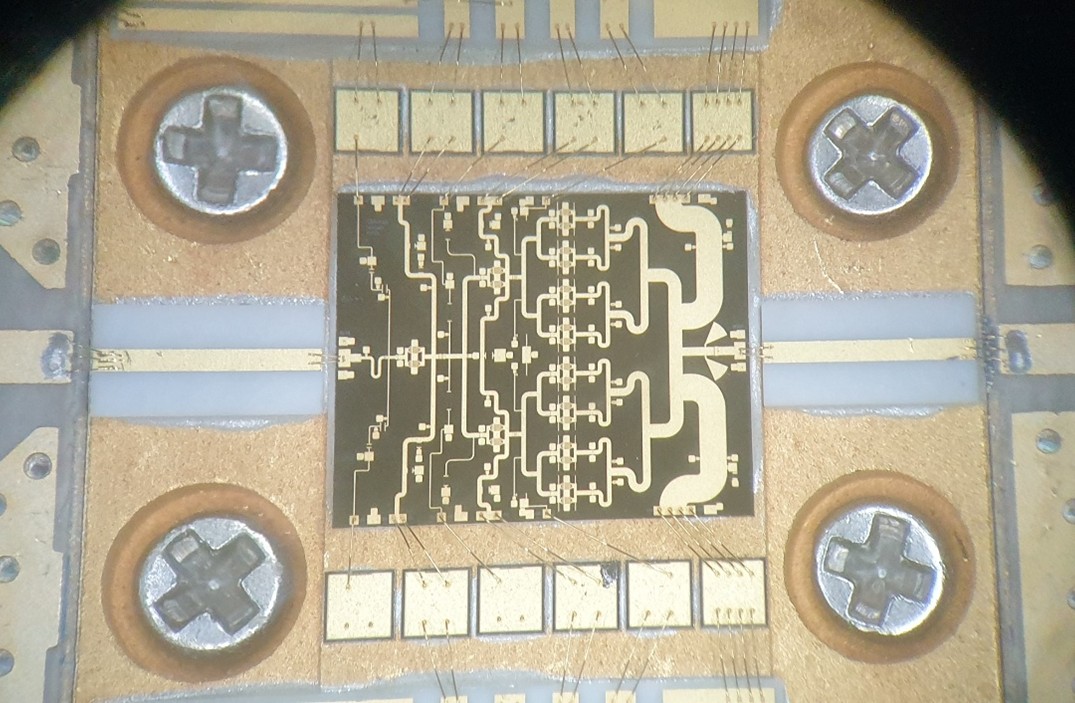
Typical Chip and Wire implementation showing MMIC die and bond wires
Alaris Linwave have the capability to handle all aspects of MMIC die processing. MMICs are received as individual die, or in wafer form which can then be sawn into individual dice. The MMIC die is then attached to a carrier using either conductive epoxy or eutectic (solder) attachment methods. Additional passive components, including capacitors and resistors, can be attached in close proximity to the MMIC. Bond wires are then added to connect the die and additional components to provide the required circuit functionality. The carrier is then attached to the main PCB/housing either using a further eutectic process or mechanical fixing with screws.
Based on years of experience, Alaris Linwave have developed several techniques to ensure a good thermal bond between the MMIC and the carrier and the carrier and the PCB. RF testing is carried out according to customer requirements. Spectrum, vector, scalar, power, noise figure, phase noise and modulation measurements up to 50GHz are available. Die probe, bond pull testing, and full environmental testing is performed as required.
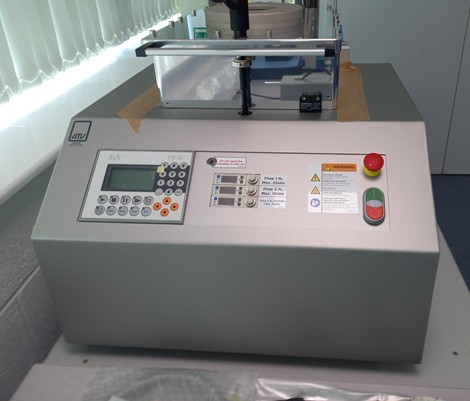
New eutectic die attachment machine recently acquired by Alaris Linwave